5. Pyrgopolinices
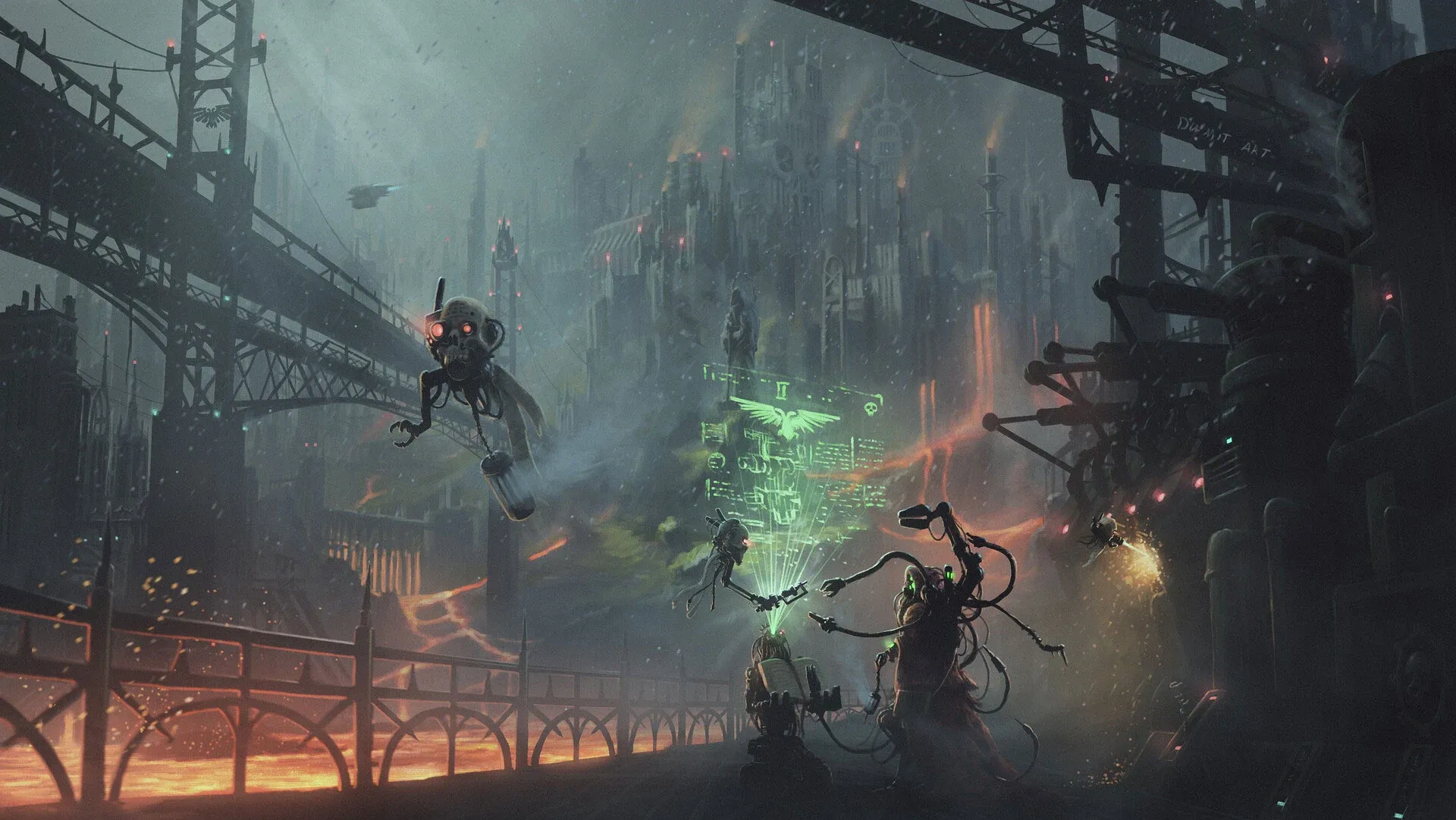
Reactivation protocols in progress, one sacred rite at the time. Illustration by DWMIT.
The Uncanny Valley
Pyrgopolinices elicited in the Mechanicus something akin to visceral unease—had those so afflicted still possessed the organs to feel it. Its paradoxes caused a profound discomfort, an almost instinctive and animal response that no augmetic had managed to erase. The scattered archives, all predating the multi-millennial isolation of the system, promised a Forge World of modest size but with a climate favourable to optimal productivity, and girded by a vast belt of orbital shipyards. The world that the Cognos Kathartis fleet discovered lay in an orbit excessively close to its sun, constantly bombarded by deadly stellar radiation. As for the shipyards, they were simply missing—as if ages of debris and wrecks could evaporate without a trace. These contradictions had sown doubt: was this truly the Pyrgopolinices of old?
The manufactorums dedicated to the construction, renewal, and maintenance of the orbital shipyards did exist—their massive structures, mostly intact, bearing witness to a once-dominant industry. Like the rest of the Forge World, they simply seemed dormant: the forges were cold, the assembly lines frozen in mineral silence. No trace of fighting or sabotage could explain such abandonment. The uncontrolled volcanic eruptions and the incessant stellar radiation alone could not have justified the complete absence of any sign of life.
One Paradox Too Many
The Adeptus Mechanicus had undertaken the tremendous task of restarting the installations. Their ambition was to rebuild the lost shipyards, thus providing a staging ground for the Quintus fleet's battle groups operating in the Orestes system. To organise this vast endeavour, the Magi sought to decipher the administrative logic that had once governed Pyrgopolinices. Their investigations led them to the Panoptican, a gargantuan structure that operated as the nerve centre for all industrial activities. A vertiginous tower rose at the heart of a circular arrangement of manufacturing complexes, all oriented toward this core of control. The Techpriests discovered fragmentary records there, some of which bore the signature of a Fabricator-General named Gero.
This information was adding yet another impossibility to a system that already had too many. The data gathered on Harpax III placed a Magos Gero at the head of the research centres during and after the Horus Heresy. How could the same individual have occupied simultaneously—or successively—the position of Fabricator-General on Pyrgopolinices? The dates did not align, the roles seemed incompatible.
Stone Gaze
As was customary for the Mechanicus when faced with uncomfortable inconsistencies, the matter was buried deep within its databanks—probably not far from the original information concerning the Forge World that had been lost and had led to its oblivion. After all, the adepts of the Omnissiah had no time to waste: besides restarting an entire world, they also had to recover the archeotech relics lying beneath its surface.
Some industrial zones had been swallowed by violent volcanic eruptions, perhaps consequences of maintenance having long ceased, or of some older upheaval. The ash and lava had petrified these sectors in their exact state at the moment of catastrophe, preserving them from pillagers, erosion, and time itself. The secrets of a glorious past slumbered within, sealed in their basalt gangue. Legions of servitors were sacrificed in these volcanic tombs, but Ulmyllon would provide more, for such was the effort required in the quest for Knowledge.