3. Ulmyllon
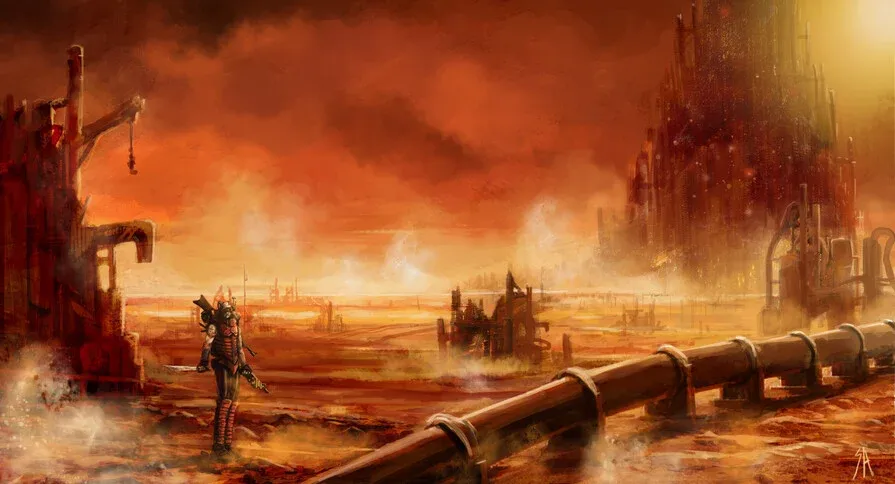
The ash wastes surrounding one of Ulmyllon's Hive Cities. Illustration by Samuel Allan.
Paradise Lost
In the minds of its inhabitants, Ulmyllon remained "the Quiescent Beauty," an affectionate nickname certainly at odds with its evident decay and the endless conflicts that pockmarked its surface with craters. Perhaps this appellation evoked the distant past of a society awaiting only the Emperor's light to awaken from its slumber. Or it was bitter irony in the face of the torpor into which the planet had sunk, in the utter indifference of the rest of humanity.
Local archives recorded a trajectory out of phase with the rest of mankind: Ulmyllon had prospered during the Age of Strife, shining through the darkness that had then engulfed the galaxy. Later brought to its knees by the infamous Horus Heresy, the Hive World nonetheless rose again to experience a second golden age, reaching its zenith during the Nova Terra Interregnum—a period once more terrible for the rest of the Imperium. This zenith inexorably gave way to dusk, brought about by internecine struggles. Some of its inhabitants were sequestered in Hive Cities, cut off from the rest of the planet. Other regions suffered from such permanent unrest that barbaric practices became sacred rituals. Now, Ulmyllon was nothing but a disparate patchwork of rival oligarchies, forgotten traditions, and stubborn superstitions—a diseased body whose limbs barely remembered they had once formed a whole.
Despite the decay of their homeworld, the people of Ulmyllon meticulously preserved several high places of the Imperial faith. Pilgrims from all over the planet still braved dangers and desolation to reach these sanctuaries. Most eminent of them all was undoubtedly the Holy Barrow of Aredius, resting place of the eponymous Saint. According to local legends, she first manifested on Ulmyllon around 750.M36, distinguishing herself notably during the "great witch hunt" that led to the total eradication of psykers. She supposedly perished in a final confrontation against the very last of them—an abhuman sorcerer with demonic features, whose name "Ganarre" still served to frighten children. For all the devotion to this martyr, the Adeptus Ministorum retained no trace of a Saint Aredius in its own archives.
“The witch-child weeps as the innocent weeps, yet the venom already flows through its veins. Pity is the first step toward heresy. Let a hundred innocents perish rather than suffer a single psyker to live.”
– Attributed to Saint Aredius, Instructions to the Confessors, circa 761.M36
A Tale of Two Hive Cities
Through civil wars, rebellions and other coups, the indigenous society had fragmented into as many rival principalities as there were functional Hive Cities. Officially or unofficially, all were ruled by oligarchs—sometimes heirs of noble bloodlines, sometimes representatives of merchant consortiums and other equally obnoxious cabals. The people, with that caustic wit that so often characterized them, nicknamed these rulers "Magni-magnates," an ironic superlative that mocked both their egos and adipose excesses.
Some of these governors had nonetheless inspired genuine respect, honoring their duty to protect their fellow citizens. None commanded more respect than Dame Cadru and Sire Amaron Morcaduc—to the great embarrassment of Imperium—in the Hive City of Mediolanum Santonum. Beyond their prestigious household heritage, the Morcaducs were the last wardens of functional Knights on Ulmyllon. Tradition held that these divine engines had been gifted by Pyrgopolinices during the Dark Age of Technology, or perhaps the Age of Strife. They were then baptised anew in honor of the Emperor when Morologus joined the Imperium during the Great Crusade, receiving the names Blessed by His Light and Touched by His Might. Alas, the siblings were reportedly declared Excommunicate Traitoris for turning their machines against Imperial forces. Indeed, when the Mechanicus declared conscription to restart its manufactorums on Pyrgopolinices, the Morcaducs took up arms to defend their city's inhabitants. The subsequent deaths of Cadru and Amaron, while more than probable, remained uncertain, as did the fate of their precious Knights.
COUCOU
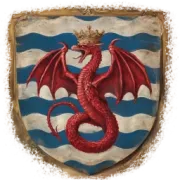
Heraldry of House Morcaduc
“Barry of Argent and Azure, over all the Ulmyllian Wyvern, Gules crowned Or."
None have beheld a living Wyvern for millennia—these endemic creatures were reportedly annihilated when Humanity claimed Ulmyllon during the Dark Age of Technology.
Not all oligarchs, however, shared such solicitude for their populace: despotism, corruption and incompetence so commonly characterized the ruling caste that one might easily have considered it a systemic phenomenon. The most notorious case was found at Scarlet Bay, the world's largest spaceport, where the calamitous governance of Colla Brass-Born had engendered an unprecedented situation. The negligence of this pitiful ruler—infamous above all else for his Dindaines, decadent feasts held at the expense of a starving population—was such that powerful workers' syndicates had been able to seize effective control of the port. Two syndicates proved especially remarkable: where Cardinal Erbette's ferocious repression upon the Imperium's arrival should have destroyed them utterly, they had instead endured and even flourished in the shadows, patiently weaving their networks of influence throughout every region of the planet.
The Ragged Trousered Philanthropists
The Cooperative Union of Loading and Transfer had become within a few decades the preeminent syndicate. Thriving on the ruins of the failing port administration, it offered organization, discipline and common purpose amid the prevailing disorder. Its growth had been swift, born from exceptional cohesion and orchestrated by the masterful hand of its young Secretary General Creni Sargail. Under her direction, the CULT had become Scarlet Bay's primary decision-making body, arbitrating commercial flows and dockworker disputes with an efficiency that might have seemed laudable, were it not for a certain unsettling fervor in the absolute devotion of its adherents.
In opposition stood the Bibic, an ancient brotherhood born from the most sordid depths of their cities. Their name, drawn from unflattering slang, evoked the unbearable nature of their stench, rumoured to be so mephitic that it troubled the vision of anyone exposed, giving the impression of seeing flies—of being bibic. Still, the syndicate's members adopted this nickname with humor, knowing it was but the least consequence of their thankless tasks. In the putrid bowels of the underhives, they were responsible for the arduous and perilous maintenance of the purification and recycling systems critical to everyone's survival. These scorned workers had initially formed their group for mutual support in the face of their labor's abominable conditions. But over the centuries, other ideas germinated in those fetid abysses. Their discreet leader, Anier Oberlion, had notably distinguished himself by spreading rumors about the existence of relics in the Saint Épur region. The Ecclesiarchy had then expended substantial resources searching for these treasures, becoming mired in what was actually nothing but a nauseating swamp born from the explosion of a gigantic water treatment plant centuries earlier. Oberlion's true intentions in this petty deception remained obscure, but it had demonstrated the Bibic's capacity to influence even the highest ranks of Ulmyllian society.
The two rival organizations, though extending their reach into all populated zones, opposed each other fiercely. Their clashes, sometimes open, bloodied the docks and underhives regularly, as if two irreconcilable visions of Ulmyllon's future were battling in the shadows, far from the Imperium's gaze.
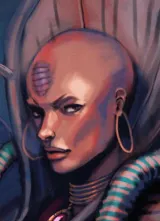
Despite her youth, the Secretary General of the CULT commands the loyalty of workers old enough to be her parents. Even the purple deformity on her forehead—a fairly common mutation in the underhives, attributed to the extreme pollution of those depths—does little to diminish her magnetism. Sargail moves through crowds with an almost dancing grace, touching a shoulder here, clasping a hand there, murmuring words that transform exhaustion into determination. Her public speeches possess a hypnotic quality, speaking of unity, of family, of a future where all of Ulmyllon's workers would form a single body. In her eyes blazes an unshakeable certainty, as if she can already see this future written in the stars.
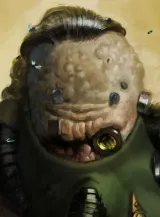
Oberlion never harangues crowds; he prefers discreet meetings, the intimacy of private conversations where he can gauge each interlocutor and tailor his jests to their temperament. “Everything flows down to our level in the end," he sometimes confides with a sincere smile, and this maxim seems less a lamentation than a comforting promise. His powers of persuasion are undeniable, for over the years it has become clear that the ideas he sows spread from one individual to the next faster than a sewer plague. The oligarchs underestimate him, seeing only a foreman ravaged by the diseases of the depths; his men, however, know that behind that respirator mask and misplaced joviality works a remarkably sharp mind, capable of obtaining through conversation alone what others only wrests through force or corruption.