1. Unveiled in Misfortune
Eti Sigrele Gabatine
At the fall of the Noctis Aeterna, a surreal tidal wave swept the entire galaxy. The Sea of Souls engulfed countless worlds in its torrents of nightmares, crushing matter beneath its daemonic breakers. It also thrust back into the Materium a great number of vessels, each isolated within its bubble of reality, all ignorant of the tragic fate of Cadia. Most of them could only watch in horror at the sudden etheric waves before they crashed against their Geller fields, annihilating their existence in an instant. Others, far rarer, managed to drag the carcasses of their ships just clear of the wake of the Cicatrix Maledictum. The Explorator Fleet Cognos Kathartis of the Basilikon Astra numbered among them.
The details that led to the catastrophic emergence of the fleet never found full record—doubtless certain experiences defied even the implacable logic of the Adeptus Mechanicus. The reports contented themselves with references to "unforeseen turbulence of exceptional magnitude." This euphemism never satisfied subsequent commissions, who blamed Archmagos Explorator Eti Sigrele Gabatine for the destruction and damage of so many precious ships. Nevertheless, none removed Gabatine from their functions, for what they came to discover likely outweighed their losses.
Initially confused as to their location, the remnants of Fleet Cognos Kathartis painfully drifted toward the nearest stellar system; despite its absence from their cartographic data, they needed to find assistance swiftly. What they encountered there only deepened their bewilderment, for orbiting the wan star were a η-class and what appeared to be a dormant Forge World.
Gabatine promptly ordered a thorough reconnaissance of the system. The auspex, though damaged, left no doubt: this Forge World bore the characteristic architectural stigmata of the Mechanicum. Furthermore, the sparse vox transmissions intercepted from the Hive World crackled in a Low Gothic dialect. How could an Imperial system—and more importantly, a Forge World—be absent from their databases?
Whether through hubris or precaution, the Archmagos decided first to keep the fleet silent, guarding their discovery from the overly curious ears of their masters—or worse still, from the Imperium. Protocol would have demanded they immediately contact the Mechanicus of Mars and the Administratum of Terra. However, the promised archeotech of a forgotten Forge World represented too precious an opportunity to share prematurely. The hordes of bureaucrats and arch-accountants would have ample time to drown them in paperwork later.
Fate, as was its custom, proved playful and hastened to force their hand: a few scant weeks passed before the auspex detected an approaching Warp signature. Then another. Then a dozen. Soon, the signatures were too numerous and erratic to warrant enumeration, but their movements left no room for doubt: an Ork flotilla was rushing straight—or at least, relatively straight—towards the system.
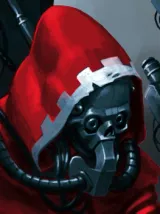
The Adeptus Mechanicus proudly considers itself a meritocracy of mathematical rigidity. Promotions are earned through demonstrated mastery of complex technical disciplines. Ranks are acquired through decades of devotion to the Omnissiah's mysteries. Knowledge, seniority, and competence determine position.
The ascension of Eti Segrele Gabatine to Archmagos Explorator meticulously contradicts every one of these principles.
Gabatine spent most of their existence as a Technomagos whose technical capabilities scarcely exceeded those of a properly programmed servitor. However, when their direct superior collapsed after striking incorrect runes upon an ancient machine, Gabatine inherited their division by mere presence. Shortly thereafter, their new superiors and their entire retinue perished in an accidental depressurization aboard the ship they had just boarded to join the Explorator Fleet Cognos Kathartis. Gabatine found themselves responsible for delivering the vessel to the fleet, and uninterrupted misfortunes ensured Gabatine was never relieved of their temporary command.
This succession of catastrophic events reached its apex at the opening of the Great Rift, when most of the fleet was lost—whereupon fate's irony ultimately placed Gabatine at the head of what remained.
Galarn Martagot
The assemblage—its aspect as haphazard as it was precarious—of flying scrap and oversized engines emerged at the edge of the system in a cascade of explosions and debris. The orkoid warships, already crude at best, bore the scars of recent battles. They clearly sought either repairs or new adversaries to fight. Probably both.
Gabatine knew their fleet was too damaged to face such a threat, or indeed any threat: their maimed cruisers maintained their orbits with utmost difficulty; the majority of their life support, propulsion, and weapons systems lay inoperative. Thus, reason managed to temper vanity, and it was with the cold logic of a theorem that the Cognos Kathartis fleet broadcast its distress call. They had spent the preceding weeks calculating—despite the manifest inaccuracy of their charts—the likely location of the nearest vox relays in the sector.
By the Grace of the Omnissiah, a response arrived far more promptly than expected. None had doubted that the mention in the distress call of an Imperial system absent from the charts would grant it a particular importance in the eyes of the Imperium and the Adeptus Mechanicus—which was precisely why Gabatine had resolved to indicate it. Nevertheless, 'prompt' did not figure among the usual qualifiers of either institution. Gabatine's pleasant surprise was however soon tinged with bitterness, for they had omitted from their calculations an ally of another nature and even less reliable. The adepts of the Mechanicus had never held love in their artificial hearts for these unvirtuous beings, always eager to negotiate lucrative contracts and rarely inclined to yield their archeotech finds without costly compensation. The instant Gabatine became aware of the message, it appeared evident to him that this ally of misfortune would become a new problem to face once the Ork threat would be contained.
Thus, Rogue Trader Galarn Martagot, captain of the Galaxy-class freighter Pugnax—of such singular appearance, from another age—and at the head of a modest but remarkably armed flotilla, emerged within the system. The precision of his emergence into realspace betrayed an exceptional Navigator and a dangerous impetuosity, particularly given the violence still roiling the tides of the Immaterium. The group, though inferior in numbers, vastly outclassed the disparate and undisciplined Ork swarm in firepower and tactical coordination. The Rogue Trader engaged the greenskins with calculated ferocity, scattering their ragged formation and destroying several of their most threatening vessels.
Entirely eradicating an Ork flotilla constituted a feat that remained for the moment beyond reach. The xenos, too numerous and too dispersed, managed to regroup in the outer reaches of the system. Worse still, some succeeded in establishing footholds on several moons and asteroids, transforming what might have remained a spatial skirmish into a tenacious and enduring infestation.
Yet, the immediate threat stood contained with very few losses for Eti Gabatine, who found themselves then compelled to "negotiate" with their savior. Martagot enjoyed a reputation oscillating between "providentially effective" and "dangerously opportunistic." The Archmagos, in a most unenviable situation, powerless and at the head of a fleet adrift, came to regret that this renown fell short of reality, as they succeeded in obtaining only the strictly indispensable aid for the survival of their group at the price of salvage rights to whatever might be discovered within this system. This new failure would likewise stand against them when scrutiny came to bear upon these events much later.
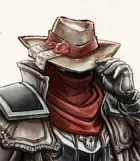
While Galarn Martagot is quick to brandish his Letters of Marque to anyone who asks to see them, his motley retinue evokes a band of pirates rather than a respectable merchant entourage. This very mismatch has bred suspicions concerning the current Martagot's identity: some deem him an unscrupulous but cunning usurper in place of a worthy representative of that noble caste.
Regardless, the Rogue Trader and his Cademandale—a Low Gothic term evoking a pack of young dogs running without apparent purpose—have built themselves a solid reputation in the sector. Their unorthodox tactics compensate for the modest means of the small merchant convoy. Martagot possesses an unsettling knowledge of obscure trade routes and displays an unerring instinct for scenting out—then seizing before anyone else—the most lucrative opportunities.
Intelligent, opportunistic, patently devoid of any sense of honor, Martagot embodies the pragmatic Rogue Trader for whom the Imperium's interests justify many compromises. His successes suffice for the Administratum. The Inquisition, however, will surely investigate this dubious character.
It was in this context of absolute urgency that Gabatine transmitted new messages, this time solely for the attention of their masters on Mars: every minute the fleet remained immobilized was an moment lost to Martagot, who hastened to establish contact with the local population and was beginning to plunder the system.
After an interminable wait, reinforcements from the Adeptus Mechanicus arrived. This time, the Archmagos's relief lasted precisely thirty-eight thousandths of a second—the time required to observe that void ships of the Navis Imperialis largely comprised the fleet. They later learned that they had not labored alone to contact the rest of mankind, for the Rogue Trader had on his side deployed considerable means and taken great risks to alert the Administratum. By informing the Imperium of this major discovery, he could initiate the bureaucratic procedures necessary to legitimize his salvage claims and ensure that none—not even the Mechanicus—could easily dislodge him. The Letters of Marque he brandished bore the seals of Terra itself, and even Mars had to reckon with such documents, provided Terra stood informed.
Nadre Bredasson
The joint force of the Navis Imperialis and Basilikon Astra proved remarkable, particularly in a context of galaxy-wide confusion, but not fortuitous: it consisted of a minor detachment from Fleet Quintus, as part of the Indomitus Crusade. Mired in a conflict that engulfed the Orestes system and its surroundings, the fleet command occasionally dispatched contingents to neighboring regions. They investigated the extent of the Xenos infestation and potential withdrawal vectors. Such reconnaissance efforts permitted the allocation of resources to verify the existence of this mysterious forgotten system.
Gabatine grasped the gravity of the events that had struck humanity as a whole through the indifference of their confreres to their failures—a mere respite—and the frank communications between the assembled forces. Indeed, beyond the present mystery, reports spoke not only of the opening of the Great Rift and the return of Roboute Guilliman, but more locally of stellar anomalies. Entire systems had vanished from charts, ancient navigation routes had suddenly changed. The "rediscovery" of a forgotten Imperial system fitted into the emerging, if incomprehensible, pattern perfectly.
Concealed from indiscreet sight and most gratified by these forces sharing their knowledge so openly, the Eye That Never Sleeps was lurking: the Imperial contingent naturally hid within its ranks a member of the Ordo Xenos, Inquisitor Nadre Bredasson. Although her presence was related only through rumors and faint whispers, it remained nonetheless dreaded by all.
It was the talents of the Inquisitor, along with her nearly limitless access to the archives of the Administratum and her questionable means of obtaining information from any other source, that first enabled her to identify the mysterious system: Morologus.
COUCOU
INQUISITORIAL TRANSMISSION
CLASSIFICATION: VERMILLION
ENCRYPTION: SIGMA-THETA-IX
FROM: Inquisitor Bredasson N., Ordo Xenos
TO: Inquisitor [REDACTED], Ordo Xenos
SUBJECT: Identification of System [COORDINATES CENSORED] - Designation: Morologus
Brother in vigilance,
I follow up on our initial conversation: the information you provided enables me this day to confirm that we have recovered the Morologus system, officially recorded for the last time during the Age of Apostasy and absent from registries since—without having been dissolved or destroyed.
However, this identification raises more questions than it resolves. The historical data partially concord with current observations, but several major discrepancies remain so far unexplained:
On one hand, the Forge World Pyrgopolinices orbits significantly closer to its star than indicated by Mechanicus records. Current orbital parameters should render nearly all industrial activity impossible, yet the observed structures appeared intact and potentially operational.
On the other hand, archives mention the existence of a substantial orbital shipyard, described as "an artificial belt worthy of the great arsenals of Mars." No trace of such infrastructure has been detected. Its complete disappearance defies all conventional explanations. More troubling still, the very position of the system within the sector does not match with recorded coordinates. The discordance is far too significant to be explained by natural phenomenon, and my observations of neighboring systems reveal a pattern far too ordered to be attributable to overflow from the Immaterium: thorough analysis of displacement vectors suggests an underlying logic, a design that appears to point towards the Nephilim sector as its nexus. The Nephilim sector itself remains shrouded in absolute silence; all contact seems impossible for the moment.
I formulate the hypothesis—which I hope erroneous—that we are witnessing the first stages of a phenomenon on a sectoral, perhaps even segmentum, scale. The xenos nature of this stellar manipulation leaves little doubt in my mind. Rare are the species that possess the technological mastery necessary for such maneuvers, and the strategic implications of such power are... considerable.
I recommend the utmost vigilance concerning Morologus. Beyond its location, its sudden emergence may prove more dangerous than providential.
The Light of the Emperor guides us through darkness.
Nadre Bredasson
POST-SCRIPTUM: The Nephilim sector demands priority investigation. Should my fears prove founded, we may face a threat of magnitude comparable to that of the Eye of Terror. I await your directives regarding the allocation of additional resources.
END TRANSMISSION

The Inquisitor seeded her conclusions—discreetly, yet efficiently—to the upper echelons of the joint force. Though the Ordo Xenos were accustomed to operating in shadow, it also knew when to share certain discoveries, if only to forestall catastrophic tactical errors.
Doubt persisted long within the Adeptus Mechanicus. Binary exchanges of uncommon virulence tore through the command of the Basilikon Astra fleet. The inconsistencies proved too numerous, and the losses they implied too painful to accept. How does one misplace an orbital shipyard? What tech-heresy would permit veiling a Forge World, displacing it by several light-years without constraint?
Yet the archives of the Mechanicus themselves betrayed their own certainties. Excavations in the deepest strata of data libraries revealed ancient references: not only to the Forge World Pyrgopolinices, but also to a research station established on Harpax III during the Great Crusade—perhaps even earlier still. These installations appeared then of notable relevance, sufficient to justify their preservation in the sacred memories of Mars.
The weeks elapsed in Byzantine debates, exhaustive orbital analyses, stellar spectrum comparisons. Finally, confronted with accumulating evidence and growing pressure from the Imperium—which could not afford to ignore an entire system simply because the charts appeared erroneous—the Mechanicus capitulated. The Imperium conceded a simulacrum of compromise—a gesture to end the objections rather than address them: the system would bear a modified designation, symbolically acknowledging the troubling discrepancies.
Morologus Novem. The name suited the system, however absurd it might appear to logicians. Lost for centuries, perhaps millennia, in the most complete indifference, the system had once more seen light by accident in the wake of the Great Rift.
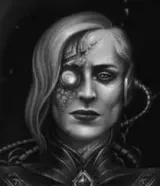
Inquisitor Nadre Brenasson belongs to the Ordo Xenos. Beyond this affiliation, information grows scarce—likely by design. She allegedly drew the enmity of elements within her Ordo after vehemently contesting their actions during the Octarius Wars. Since then, she has reportedly operated in the Ultima Segmentum, though her name appears on no official reports.
Many of her peers wield their authority with the subtlety of a Boltgun. Brenasson, by contrast, embodies the dagger that strikes from shadow or the poison slipped into the cup. She investigates without fanfare, cultivates the opacity of her objectives, moves through interstices the light never reaches.
Whether Brenasson currently finds herself in the Morologus Novem system to investigate, manipulate, or merely observe remains an unanswered question. None would be reckless enough to ask her.
Given the system's considerable potential in both resources and strategic value, the detachment of the fleet Quintus obtained the authorization to secure it and undertake joint recovery operations. The priorities were clear: secure Pyrgopolinices, eradicate the persistent Ork infestation, and establish contact with local populations—for though they did not yet know it, the Imperial tithe would soon fall due upon them.
Ulmyllon became the first destination of official reconnaissance. As the most distant inhabited world from Morologus Novem's star, this Hive World represented a vital Imperial objective. Where the archives—fragmentary and obsolete for millennia—described a world teeming with activity, the forces of the Imperium found desolation; only a fraction of the population had survived.
Life in the hives was brutal. Malnutrition reigned in the lower levels. Infrastructure crumbled in the best of cases; more often, it represented a permanent and lethal danger, not unlike the merciless jungles of some Death Worlds. Atmospheric recycling systems struggled to maintain breathable air. Despite their misery, the inhabitants greeted the Imperial forces as one welcomes deities descended from the heavens.
Although fractured and weakened by incessant conflicts, local authorities prostrated themselves for the most part before the emissaries of the Emperor. Their accounts, confused and often contradictory, splattered the canvas of multi-century isolation with the blood of constant civil and religious wars. Ulmyllon had lost all contact with the rest of its system, then the rest of the galaxy so long ago that the very reasons for these ruptures had blurred into myth and superstition.
As for local archives, where they still existed, they revealed only little to no information. Generations of crises, massacres, and various catastrophes had reduced them to scattered fragments, indistinctly mingling facts and tales. The calendar itself testified to this confusion: according to local dating, humanity remained still in repentance for the Apostasy. The gap with the meticulous calculations of the Ordo Chronos, upon which Bredasson kept attentive watch, reached several thousand years for the region.
Laudes Erbette
The confusion between myth and reality in local folklore had inevitably altered the Imperial Creed. The Ecclesiarchy, upon learning of this theological drift, hastily established spiritual reconquest missions across the entire system. After all, such deviances had been observed after contacting the first world. Who knows what heresies might fester among the populations of the others?
What the preachers discovered exceeded their initial fears: though the Creed had endured, it had mutated across the centuries, interweaving dark fables, heretical beliefs, and theological interpretations no Cardinal would have sanctioned. Local priests still venerated the God-Emperor, but their liturgies and rituals reeked of corruption from xenos influences, their sanctuaries displayed troubling iconography.
Henceforth, Cardinal Laudes Erbette, charged with supervising the operation, deployed a purification mission of immense ambition. Preachers thundered from public squares, confessors catalogued deviations, all under the menacing gaze of forces of the Adepta Sororitas, ever ready to deliver more than sermons to the unfaithful.
But starvation and exhaustion had not weakened the inhabitants' faith. They warmly accepted these "corrections" as the reassuring embrace of the Emperor they had so missed. In these circumstances, the rare murmurs of discontent proved negligible, and the revolt that would soon erupt would be all the more disconcerting.
The restoration of the one true Imperial Creed progressed at lightning speed. Cardinal Erbette already busied himself drafting a triumphal report—which would doubtless constitute the apex of his memoirs. All was well, until the increased presence of the Adeptus Mechanicus triggered a series of events that would sweep away the entirety of his efforts.
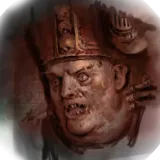
Cardinal Laudes Erbette personifies the faith of the Adeptus Ministorum in its most intransigent form. His career, as he delights in recounting it, comprises a glorious series of conversion campaigns throughout the Imperium. Every account highlights his theological insight, his unshakeable devotion, his exceptional ability to shepherd the lost back to the Emperor's embrace.
What the Cardinal systematically fails to mention is that none of these campaigns endured beyond his departure. Erbette's successors generally find that his "achievements" rely upon absolute and unbridled repression rather than genuine conversion.
Nevertheless, the Cardinal remains powerful, dangerous, and profoundly certain of his own spiritual brilliance. His vanity knows no equal save his fanaticism, and both nourish one another to create a figure as pitiable in his delusion as he is fearsome in his authority. The Ecclesiarchy dispatches him wherever purifying fire must consume heresy. That the flames leave only barren ashes instead of rekindled faith concerns him not in the slightest.
With the work of the Adeptus Ministorum seemingly nearing completion, the tech-priests began deploying openly throughout the inhabited Hive Cities. Their servo-skulls coursed through corridors, cataloguing, calculating, evaluating. Their delegates met with governors, for without further delay, the workforce necessary for the renaissance of Forge World Pyrgopolinices must be selected.
Relations with the population deteriorated immediately: condescension toward local culture—barbaric and ingenuous—had led both the Imperium and the Mechanicus to ignore numerous warnings. Thus, for inhabitants of many of the Hive Cities, the "Necromancers of Iron" had been the source of ills from which the entire system had suffered for centuries, ultimately depriving it of the Light of the Emperor. Elders spat at the mention of Pyrgopolinices. Parents clutched their children close when the cowled silhouettes of tech-priests crossed public squares.
This aversion seemed deeply rooted in the collective memory, far beyond simple mistrust of technology. Legends spoke of mass abductions, of machines devouring men, of metallic abominations rising from the ground to hunt the living. Only much later—far too late—and in light of the coming tragedy did Bredasson conjecture that traditional accounts had likely amalgamated Tech-Priests, Men of Iron, and perhaps even xenos entities.
The Adeptus Mechanicus dismissed these superstitions with a mechanical gesture. The archives were formal: Ulmyllon had historically served as a labor reservoir for the forge world. Tradition would perpetuate itself. An accord came to pass with the governors—or rather, an ultimatum. Mass levies would commence shortly. Millions of individuals would be conscripted to labor toward the rebirth of Pyrgopolinices.
The Purified and the Tamed
From all quarters, violent revolts erupted. Most disconcerting was the steadfast—some would say heroic—support shown by a significant portion of the ruling oligarchy for their people. These same families who had immediately bowed with reverence before the emissaries of the Emperor now preferred death to surrendering their subjects to the Mechanicus.
The apparent simultaneity of the rebellion and its coordination raised questions. Perfidious xenos or daemonic interference offered a convenient explanation—one that absolved the Imperial forces of blame. Consequently, a consensus was swiftly reached on both problem and solution: they identified two of the Hive Cities where the uprising seemed most significant—twin Hive Cities—and vitrified them from orbit.
Brutal, cruel, and inexorable, the repression broke the inhabitants. Other foci of rebellion slowly extinguished themselves. Entire lineages of seditious governors were likewise destroyed, under the horrified stare of a powerless population. The most zealous oligarchs, for their part, seized this opportunity to fill the void thus created and reinforce their positions.
An Imperial decree definitively sealed the fate of the twin cities: mentioning their existence would constitute a crime punishable by summary execution. They would vanish from archives, from charts, from memory. Ulmyllon had never counted more than three Hive Cities. To assert otherwise amounted to propagating heresy.
Thus concluded the pacification of Ulmyllon, and the war effort resumed as planned. The conscription commenced, organized this time with implacable efficiency under the joint supervision of the Adeptus Arbites and the Mechanicus. Millions of souls found conveyance to Pyrgopolinices, where dormant forges awaited rekindling.
The Adeptus Ministorum redoubled its purification missions, vigilant that no theological deviance should persist to contaminate future generations, though no doubt remained that the underhives still harbored the last unbelievers.
Morologus Novem stood henceforth fully integrated into the fold of the Imperium, washed of its sins by purifying fire and spilled blood. Official reports would mention "successful reintegration despite some minor incidents." Civilian losses would be found "within acceptable parameters." And no one, absolutely no one, would ask questions about the two vitrified craters that gleamed upon the surface of Ulmyllon like fresh scars.